Skip to content

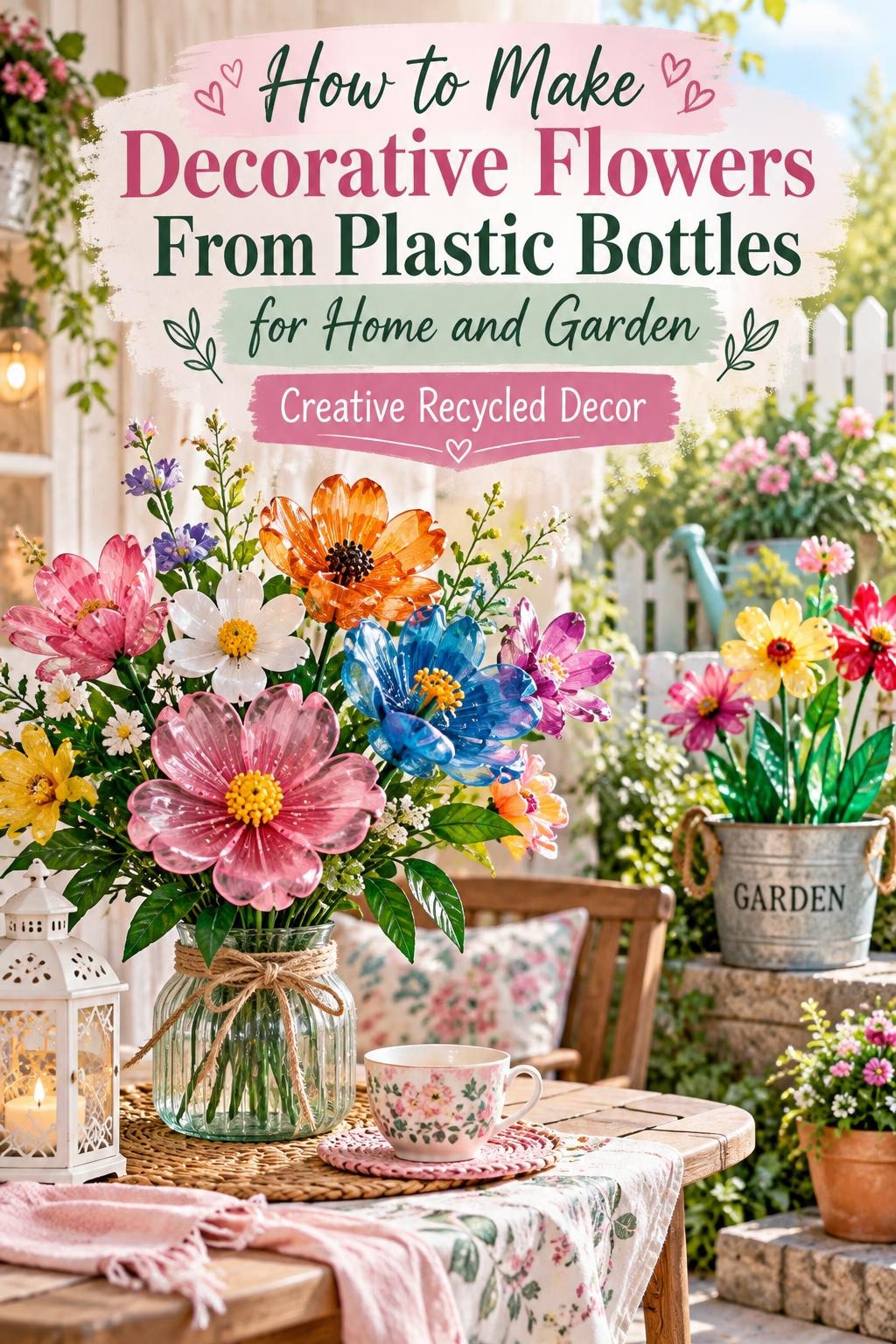
Every plastic bottle that ends up in a recycling bin had a second life available to it — one that’s considerably more beautiful than the first. With a pair of scissors, some paint, and about an hour of your time, those bottles can become something genuinely lovely: sculptural flowers that stand in garden beds, hang on walls, sit in vases, and weather every season without wilting.

The best part isn’t even the environmental win — though that’s real and meaningful. It’s that plastic bottle flowers can be made to look genuinely beautiful when approached with the right techniques. Not crafty. Not obviously recycled. Just flowers — decorative, durable, and completely free to make.
What You’ll Need
Source your materials from your recycling bin before buying anything. Most of this you already have.
- Plastic bottles — a mix of sizes and shapes gives you petal variety. Water bottles, soda bottles, and detergent bottles all yield different flower forms.
- Sharp scissors or craft knife — plastic cutting requires a sharp blade, not a dull one
- A heat source — a candle flame or lighter for heat-shaping petals (adult supervision essential, and good ventilation)
- Acrylic paint and a brush — or spray paint for faster, more even coverage
- Wire — floral wire or thick garden wire for stems
- Wire cutters
- Green floral tape for wrapping stems
- Strong waterproof glue or a glue gun
- Optional: nail polish for glossy petal details, glitter, or outdoor Mod Podge for weather sealing

Understanding How Plastic Becomes Petals
Before cutting anything, it helps to look at your bottles differently — as raw material with structural potential rather than as waste.
The parts of a bottle and what they make:
- The body — the tall cylindrical section. Cut into strips lengthwise for long, elegant petals. Cut into rings and then shaped for rounded, cupped petals.
- The base — the bottom of the bottle, particularly on soda bottles with the moulded petal-shaped base, is literally already a flower form. Cut the base off cleanly and you have an instant five-petal flower shape.
- The neck — too narrow for petals but excellent for flower centers when cut and fanned outward
The heat-shaping secret:
Raw cut plastic is flat and stiff. The magic happens when you briefly pass a petal shape over a candle flame — the plastic softens almost instantly and curls, cups, and shapes into natural-looking petal curves. Remove from heat the moment it starts moving and hold it in your chosen shape for three seconds while it cools and sets. This single technique is what separates plastic bottle flowers that look realistic from ones that look obviously recycled.
Making Your First Flower — The Classic Five-Petal Form

This is the easiest entry point and produces the most consistently beautiful results.
- Take a standard soda bottle and look at the base — it already has five curved segments moulded into it.
- Cut the base off about 3cm up from the bottom using sharp scissors. You now have a ready-made five-petal flower shape.
- Refine the petal edges — cut each petal to a rounded or pointed tip depending on your preferred flower style. Rounded tips read as roses or ranunculus; pointed tips read as dahlias or chrysanthemums.
- Heat-shape the petals — pass each petal briefly over a candle flame one at a time, curling it slightly backward for an open bloom effect, or cupping it forward for a more closed, budlike form. Work quickly and carefully.
- Make a second, smaller flower from a smaller bottle base for layering — placing a small flower inside a larger one creates immediate depth and realism.
- Pierce the center with a heated wire or skewer and thread your floral wire stem through from below, bending a small hook at the top to anchor it.
Painting for Maximum Realism

This is the step that makes everything look intentional — and it’s worth slowing down for.
Colour approach for realistic flowers:
- Start with a white base coat on all petals — this neutralises the original bottle colour and gives every subsequent colour true accuracy
- Build depth with two tones of your chosen colour — a lighter base and a slightly deeper shade brushed toward the petal tips or center
- Add veining with a fine brush — thin lines of a deeper tone drawn from the center outward mimic the structure of real petals and add extraordinary realism
- Dry-brush white highlights along the raised curves of each petal for a luminous, three-dimensional effect
Colour combinations that work beautifully:
- Soft white with pale pink tips — classic rose
- Deep coral base with golden yellow center — garden dahlia
- Pale lavender with deeper purple veining — wildflower
- Pure white throughout, sealed with Mod Podge — sculptural and modern
Let paint dry completely before assembling — at least one hour, longer in humid conditions.
Assembling and Displaying Your Flowers
Glue your layered flower forms together with a glue gun — a small dot in the center holds everything. Add a button, a bead, or a circle cut from a bottle cap as the flower center for a finished, professional look.
Wrap your wire stems tightly with green floral tape, stretching the tape slightly as you wrap so it adheres to itself. Start at the flower base and spiral downward in overlapping passes.
Display ideas that make plastic bottle flowers look stunning:
- Garden stake flowers — push long wire stems directly into garden beds or potted plants for an instant garden art installation
- Wall-mounted bouquet — wire stems twisted together and mounted on a piece of driftwood or a simple wooden frame
- Vase arrangement — mixed with real dried flowers or greenery, plastic flowers hold their own beautifully in an arrangement
- Wreath addition — wired onto a grapevine wreath base with seasonal greenery

Beauty Made From Nothing
A plastic bottle is twelve minutes from becoming a flower. That’s it. And once you start seeing bottles as petal material rather than waste, it’s genuinely hard to look at them the same way.
Save this project and share it — with a friend who gardens, a teacher looking for classroom projects, or anyone who needs proof that beautiful things can come from unexpected places. Make a whole bouquet and see if anyone realises what they’re actually looking at.