Skip to content
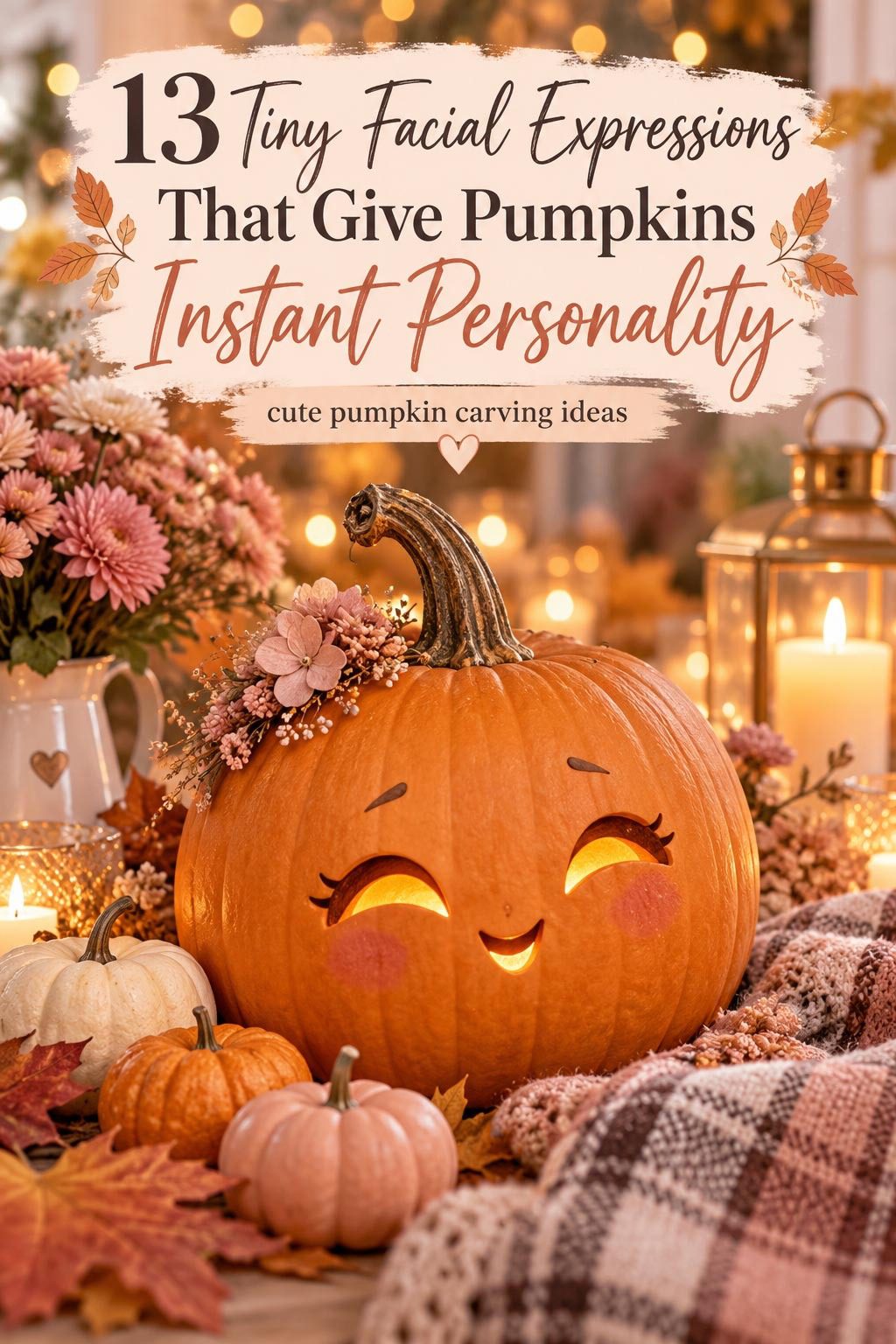

Most pumpkin faces look the same — two triangle eyes, a jagged mouth, done. The problem is not the carving skill, it is the lack of expression. A face without a readable emotion is just a face. But change the angle of an eyebrow by one cut, curve a mouth slightly differently, or add a single eyelid line, and suddenly your pumpkin has a personality that makes people stop and look twice. Tiny facial expression details are what separate a forgettable jack-o’-lantern from one that gets photographed and shared. This guide covers 13 specific expression techniques — each one achievable with basic tools, each one producing a completely different character from the same orange sphere.

1. The Wide Delighted Grin
A delighted grin reads completely differently from a standard jack-o’-lantern smirk. The secret is the rounded cheek detail on either side of the mouth.
Use a shallow relief carving technique — remove only the outer skin of the pumpkin without cutting all the way through — to carve two rounded cheek shapes flanking the mouth opening. These raised cheek areas catch the interior light differently from the cut-through mouth.

The mouth itself should curve upward at both corners in a genuine wide curve. A flat-bottomed mouth with upward tips looks like a real smile rather than a grimace.
Make the eyes wide and circular rather than triangular. Full circles suggest openness and delight. Add small circular pupils inside each eye using the same shallow relief carving — a dark circle within a glowing circle.
The combination of wide circular eyes, cheek relief carving, and a genuinely curved upward mouth creates an unmistakably joyful expression.
Carving Tip
Practice the cheek relief technique on a section of cut-off pumpkin lid first. Relief carving requires removing about 5mm of outer rind without puncturing through to the hollow interior. A small V-shaped linoleum carving tool handles this more precisely than a kitchen knife.
2. The Panicked Surprise Face
A surprised face made entirely from circles and one asymmetric eyebrow is one of the most expressive and fastest expressions to carve — and the asymmetric detail is what makes it feel genuinely alarmed rather than just neutral.
Cut two large circular eyes and one large circular mouth. All three circles create the basic surprised expression. But the key upgrade is adding a single raised eyebrow on one side only.

Carve a shallow relief arch above one eye — not above both eyes. The asymmetry is what creates the panicked, frantic quality. Both eyebrows raised looks theatrical. One eyebrow raised looks genuinely disturbed.
Make the open circular mouth large — at least as wide as the distance between the outer edges of both eyes. A small circular mouth suggests mild surprise. A large circular mouth suggests genuine alarm.
The rounder and larger the features, the more exaggerated the surprise. Push the scale of each element slightly beyond what feels natural.
Carving Tip
Round circles are harder to cut cleanly than straight lines. Use a small round cookie cutter pressed into the pumpkin surface before cutting to score a clean circular guide. Then follow the scored line with a short-bladed paring knife using a rocking push motion around the curve.
3. The Thunderously Grumpy Scowl
A grumpy expression is achieved through two primary elements — angled eyebrows pointing sharply downward toward the center, and a mouth that curves downward rather than upward.
Carve two eyebrow lines angling from high outer corners down to low inner corners directly above the eyes. The steeper the angle, the angrier the expression. These eyebrows do not need to be thick — a single shallow relief cut for each brow is enough.

The eyes themselves work best as narrow horizontal slits rather than full circles or triangles. Narrowed eyes suggest concentrated displeasure.
The mouth must curve downward at both corners — not flat, not upward. Even a slight downward curve at each mouth corner reads clearly as a frown. Exaggerate it slightly for maximum grumpy effect.
Keep the face symmetrical. An asymmetric grumpy expression reads as confused rather than angry. Perfect symmetry in the angry expression communicates a consistent, directed emotion rather than a scattered one.
Carving Tip
The most common mistake when carving grumpy expressions is making the mouth too short. A wide downturned mouth reads as deeply unhappy. A small downturned mouth reads as mild disapproval. For a dramatically grumpy pumpkin, make the mouth at least half the face width.
4. The Mischievous One-Sided Smirk
A smirk is one of the hardest expressions to carve and one of the most rewarding when it works. The entire expression depends on asymmetry — one side of the mouth higher than the other.
Draw the mouth before cutting. The left corner sits lower than the right corner, or vice versa. The higher corner suggests the smirk side. The lower corner hangs slightly open — the smirk pulls one side upward while the other side stays neutral.

On the same side as the higher mouth corner, add a single raised eyebrow using shallow relief carving. This eyebrow echoes the raised corner of the mouth, reinforcing the knowing, one-sided quality of the expression.
The eye on the smirk side should be very slightly more closed than the opposite eye — just one small extra cut along the lower edge of that eye.
Carving Tip
The three elements of the smirk — raised mouth corner, raised eyebrow, and slightly closed eye — must all be on the same side of the face. If they are on opposite sides the expression becomes confused rather than smirking. Draw all three elements in marker before cutting anything and check the composition from a distance.
5. The Exhausted Sleepy Expression
A sleepy pumpkin is one of the most charming and comedic expressions available — and it is created almost entirely through the drooping eyelid detail.
Carve the eye openings as standard ovals or circles. Then use shallow relief carving to add a drooping upper eyelid curve across the upper half of each eye. The relief carved eyelid hangs over the top half of the glowing eye opening, creating a heavy-lidded half-asleep appearance.

The heavier and droopier the upper eyelid curve, the sleepier the expression. Carve the relief eyelid to cover about 40–50% of each eye opening for the most convincing tired look.
The mouth should be a flat, very slightly downturned straight line — not an angry frown, just the neutral downward pull of exhaustion. A mouth that is completely flat reads as a zombie. Slightly downturned reads as genuinely tired.
Keep the face symmetrical — both eyes equally droopy, both mouth corners at the same height. Symmetrical exhaustion reads as shared tiredness rather than injury.
Carving Tip
The drooping eyelid relief carve is one of the most expressive single details you can add to any pumpkin expression. It works on top of almost any other expression to transform it — an angry face with droopy eyelids becomes a tired angry face. A surprised face with droopy eyelids becomes an overwhelmed face.
6. The Playful Wink
A winking pumpkin has an immediately conspiratorial, playful quality — it looks like it is sharing a joke with whoever is looking at it.
One eye is open as normal. The other eye is replaced entirely with a shallow relief carved closed eye — a curved arc suggesting a shut eye with the suggestion of lashes if you want extra detail. The closed eye does not glow from the interior because it is not cut through — it sits as a dark curved shape against the orange skin.
The contrast between the glowing open eye and the dark closed eye is the visual effect that makes the wink read so clearly.
Add a slight upward curve to the mouth on the same side as the winking eye. This small mouth adjustment reinforces the knowing, playful quality of the expression — a wink with a neutral mouth reads as strange, but a wink with a slight smile reads as friendly and conspiratorial.
Carving Tip
The closed winking eye works best when carved with a slight downward bulge at the center of the arc — this curve suggests a closed eye under tension rather than just a flat line. Think of how a real winking eye pulls slightly outward at the cheek. Even a very subtle curve in the relief carve communicates this convincingly.
7. The Genuinely Frightened Face
A frightened expression uses angled eyebrows that point upward toward the center — the opposite direction from an angry scowl’s inward-pointing eyebrows.
Angry eyebrows angle down toward the center. Frightened eyebrows angle up toward the center. This single directional difference is the key distinction between a scary pumpkin and a frightened pumpkin.

Wide, slightly uneven eyes reinforce the fear expression. Make one eye fractionally larger than the other — real fear is rarely perfectly composed. The slight asymmetry in eye size reads as genuine distress rather than theatrical performance.
The mouth should be open wide — a large jagged opening that suggests a scream rather than a growl. Add upper teeth at the top edge of the mouth opening by cutting square tooth shapes along the upper edge of the cut.
The overall expression communicates fear rather than menace — a pumpkin that is frightened of you rather than frightening. This comedic reversal is immediately amusing and makes for an excellent doorstep conversation piece.
Carving Tip
Upward-angling frightened eyebrows are often more difficult to cut convincingly than downward-angling angry ones because the natural tendency when carving is to pull the knife downward. Carve frightened eyebrow lines from the outer edge inward toward the center — working from high outer corner to low inner corner — to maintain the upward angle naturally.
8. The Smug Self-Satisfied Expression
A smug pumpkin is perhaps the most personality-rich option on this list — it looks genuinely pleased with itself, as though it has just won an argument it was not supposed to win.
The smug expression requires three elements in precise coordination. One high arched eyebrow on one side — carved as a pronounced upward arch, not a straight line. One flat or slightly lowered eyebrow on the opposite side. And a mouth with one corner raised slightly higher than the other.

The arched eyebrow and the raised mouth corner should be on opposite sides of the face — this cross-expression creates the specific smug quality where one side of the face shows pleased amusement and the other shows cool composure.
Eyes that are slightly narrow rather than wide open reinforce the self-satisfied quality. Closed, confident eyes suggest someone who does not need to look alert because they are already ahead of whatever situation they are in.
Carving Tip
The high arched eyebrow is the most expressive single element in this face. Carve it as a proper arch rather than a straight line — a flat line reads as neutral or skeptical. The curve of the arch rising high above the center of the eye and descending back down on each side communicates genuine theatrical smugness.
9. The Baffled Confused Expression
A confused pumpkin uses deliberate visual inconsistency — different eye shapes, asymmetric eyebrows in opposite directions, a wavy uncertain mouth — to communicate genuine bafflement.
Make the two eyes different shapes from each other. One triangle eye, one circular eye. The mismatch communicates a face that is not sure what it is looking at.

One eyebrow angles sharply upward. The other angles sharply downward. Having the eyebrows go in completely opposite directions is the fastest way to communicate confusion — the face looks like it is having two contradictory reactions simultaneously.
The mouth should be a wavy, indecisive line — not curving clearly upward or downward, but going in an irregular wave that suggests a face that cannot commit to any single expression.
The more inconsistent and asymmetric the overall face, the more convincingly confused it reads.
Carving Tip
For the wavy confused mouth, draw it in marker first and practice keeping the line genuinely wavy rather than straight. The temptation when cutting is to follow a straight path — resist this and maintain the deliberate irregularity of the drawn line all the way through the cutting process.
10. The Softly Happy Squinting Eyes
Happy squinting eyes are one of the most universally appealing expressions available in pumpkin carving — and they are made from crescent shapes rather than standard triangle or circle eyes.
Cut the eyes as upward-curving crescent shapes — like crescent moons with the opening facing upward. These crescent eyes suggest eyes squinted from genuine happiness rather than from sleepiness.
The crescent shape communicates that the cheeks have pushed up from a smile — the eyes are not wide open because the happiness is compressing them from below.

Pair with a wide, gently curved upward mouth — not a toothy grin, just a smooth upward arc. The combination of softly squinting crescent eyes and a gentle curve mouth creates a warmly content expression rather than a broadly excited one.
This expression suits pumpkins placed in warm domestic settings — front door displays, mantelpiece arrangements, and tabletop groupings where a gentler, less menacing expression suits the setting better than a traditional jack-o’-lantern face.
Carving Tip
Crescent shapes cut cleanly when you work from the inner tip of the crescent outward along each side. Cutting toward the pointed ends of a crescent is easier than cutting away from them — the knife blade follows the curve naturally when moving toward the pointed terminal.
11. The Theatrical Crying Face
A crying pumpkin is one of the most dramatic and comedic expression options — the theatrical sadness creates an immediate humor response that makes it a crowd favorite at any Halloween display.
Carve the eyes as standard oval or round openings. Then add teardrop-shaped openings trailing downward from each eye — these cut-through teardrop shapes glow from the interior, suggesting streams of tears flowing down the face.
The teardrop tear shapes should be narrow at the top where they meet the eye and slightly wider at the bottom where they taper to a point. Two or three tear shapes per eye, descending in a slightly curved path, creates a convincing cry.
The mouth should curve dramatically downward — more exaggerated than a simple frown. Pull the corners sharply downward and add a slight open gap at the center of the mouth to suggest an open crying mouth.
Carving Tip
The teardrop tears are the specific detail that makes this expression immediately readable. Without them, a downturned mouth is just a sad face. With the glowing tear trails, it becomes unmistakably theatrical crying. Cut the tears in a gentle outward curve rather than straight down — tears on a real face trace a slightly outward path as they follow the curve of the cheek.
12. The Exasperated Eye-Roll
An eye-rolling pumpkin is one of the most expressive personality options available — it reads immediately as thoroughly unimpressed, and the humor of a pumpkin expressing existential boredom is irresistible.
Carve the eyes as large circles. Then carve small circular pupils at the very top edge of each eye opening — the small circles sit at the upper boundary of the larger eye circle, as close to the top edge as possible without merging with it.

When lit from inside, the large circular eyes glow brightly while the small top-positioned pupils appear as dark circles within the glow. The contrast between the large glowing eye and the small dark top-positioned pupil creates the unmistakable eye-roll effect.
Pair with a completely flat mouth or a very slightly downturned flat line — the resigned, expressionless mouth of someone who has seen everything and is no longer surprised by any of it.
Carving Tip
The pupil positioning is everything in this expression. Pupils centered in the eye create a neutral expression. Pupils at the top edge create the eye-roll. Test the pupil position by placing a small battery LED inside before carving — you can hold cut-out paper circles against the inside of the eye opening to check the visual effect before committing to the final cut.
13. The Minimal Knowing Smirk
The most subtle expression on this list requires the fewest cuts — and often reads as the most intelligent character in any group of pumpkins.
Carve two narrow horizontal eye slits — just straight cuts, no curves, no pupils. The minimal eyes suggest composure rather than emotional animation.

The entire expression depends on a single tiny upward curve at one corner of an otherwise flat horizontal mouth. The mouth is a straight horizontal cut with one end — just one end — angled very slightly upward.
That single fractional curve at one mouth corner is enough. The brain reads the asymmetry immediately as a knowing, privately amused smirk.
The contrast between the minimal eye expression and the barely-there smirk creates a face that appears to be watching everything and finding all of it slightly amusing.
Carving Tip
This expression requires precision over scale. The upward curve at the mouth corner should be only a few millimeters of deviation from horizontal — too pronounced and it becomes a lopsided grin rather than a smirk. Draw the mouth in marker first and step back to assess the angle before cutting. The subtlety is what makes this expression work.
Conclusion
A pumpkin’s expression is the difference between a decoration that people walk past and one that makes them stop and genuinely react. The 13 expression techniques in this guide each produce a completely distinct personality from the same basic materials — one pumpkin looks delighted, the next looks smugly knowing, another looks theatrically devastated. None of these expressions require specialty tools or advanced carving skills. They require understanding what specific details — eyebrow angle, eye shape, pupil position, mouth curve asymmetry — actually communicate emotion at a glance. Start with the expression that appeals most to you, draw it in marker before you cut, and step back from the pumpkin every few minutes to assess the whole face from a distance. One cut changes everything. Make it intentionally.